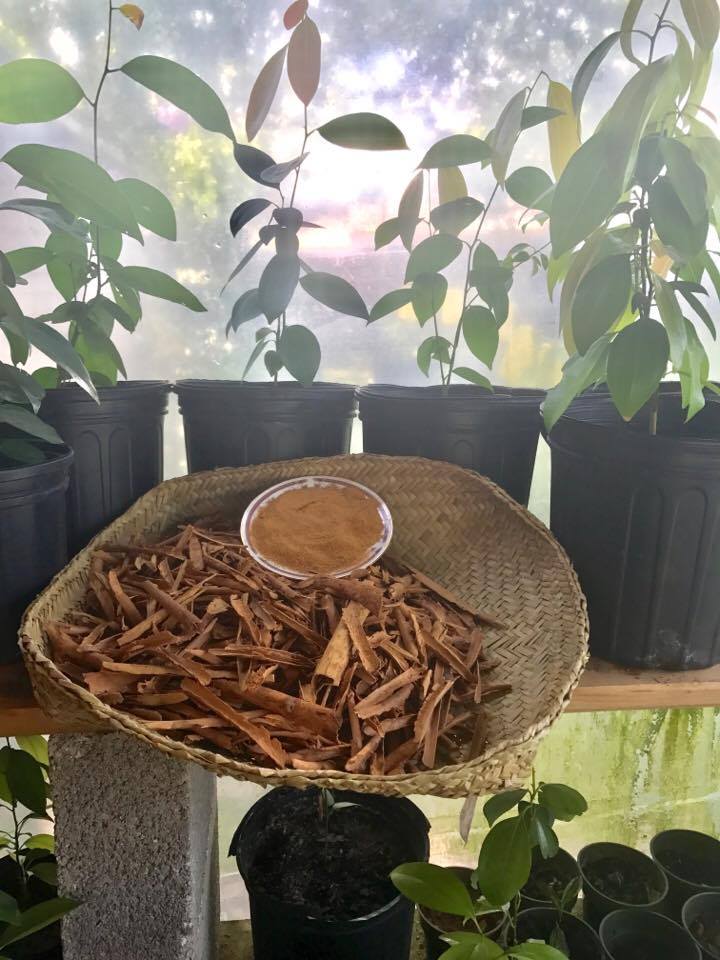

Cost per 4 ft Plant (RGH001D) $65.00 @ + shipping
Cost per 18" plant 3 gal bucket (RGH001C) $40.00 @ + shipping
Cost per 12" plant 2 gal bucket (RGH001B) $30.00 @ + shipping
Cost per new growth plants 4- 6 inches 4.5 inch pot (RGH001A) $20.00 @ + shipping
for large orders contact us for discount
Cinnamon
(Cinnamomum verum)
RGH001
|
 |
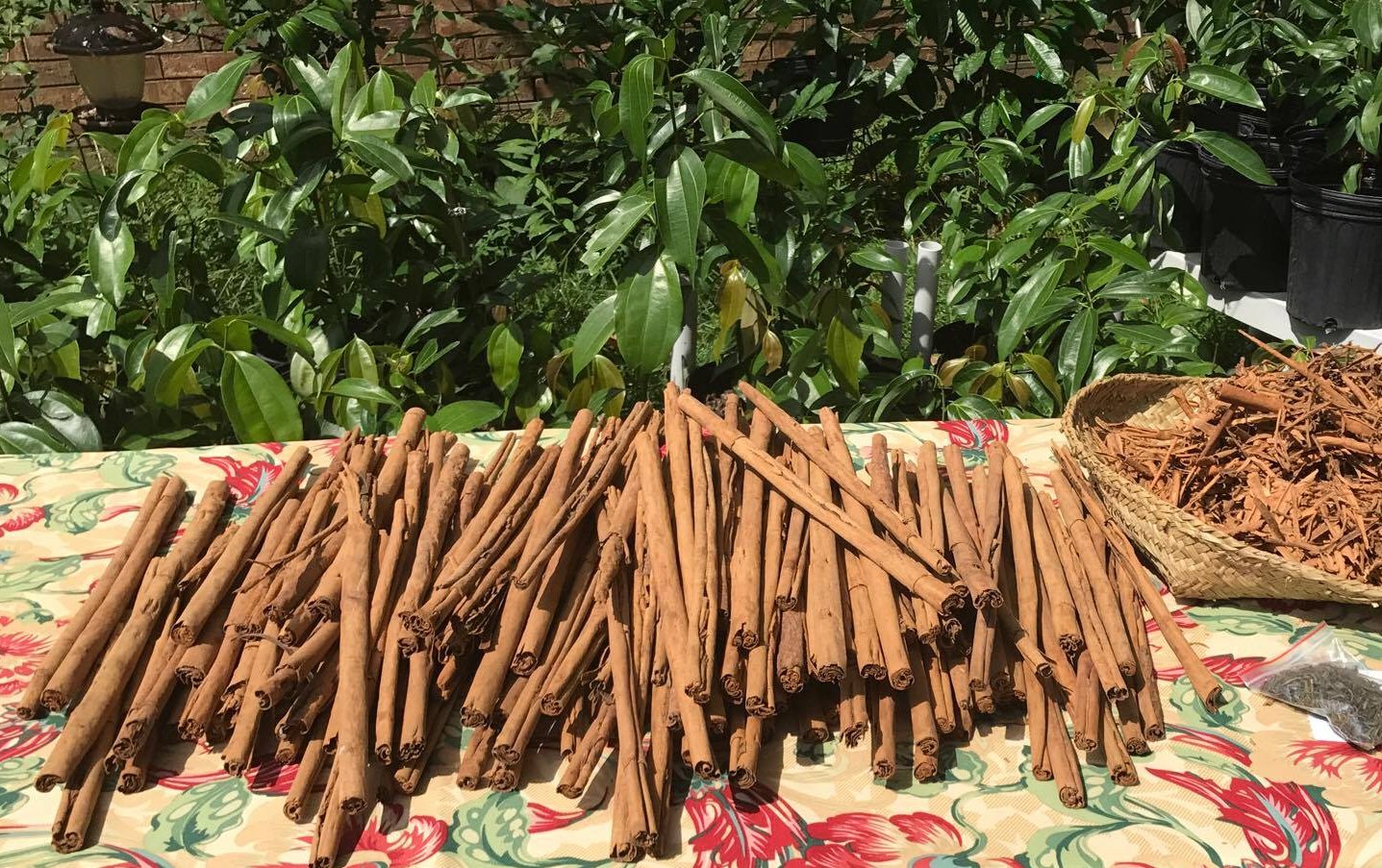 |
Strongly aromatic, sweet pleasant and warm.
Cinnamomum verum, called "true cinnamon tree" or Ceylon cinnamon tree is a small evergreen tree belonging to the family Lauraceae,
native to Sri Lanka. Among other species, its inner bark is used to make cinnamon.
Ceylon cinnamon thrives in USDA zones 9 through 11,handles mild frosts down to 32°F but needs protection from harder frosts. It grows best in well-drained, acidic soil when it receives full sun to partial shade.Cinnamon is the hardiest among the tree spices, tolerating a wide range of soil and climatic conditions. The ideal climate has an average temperature between 80-86°F and 79-89 inches of rainfall. Cinnamon is an evergreen tree that is kept to a height of 6-9 ft. The soil conditions are very important, as waterlogged soil will produce a bitter cinnamon bark. Grown in a 12- to 14-inch container, Ceylon cinnamon trees can be pruned to maintain a maximum height of 3 to 8 feet.
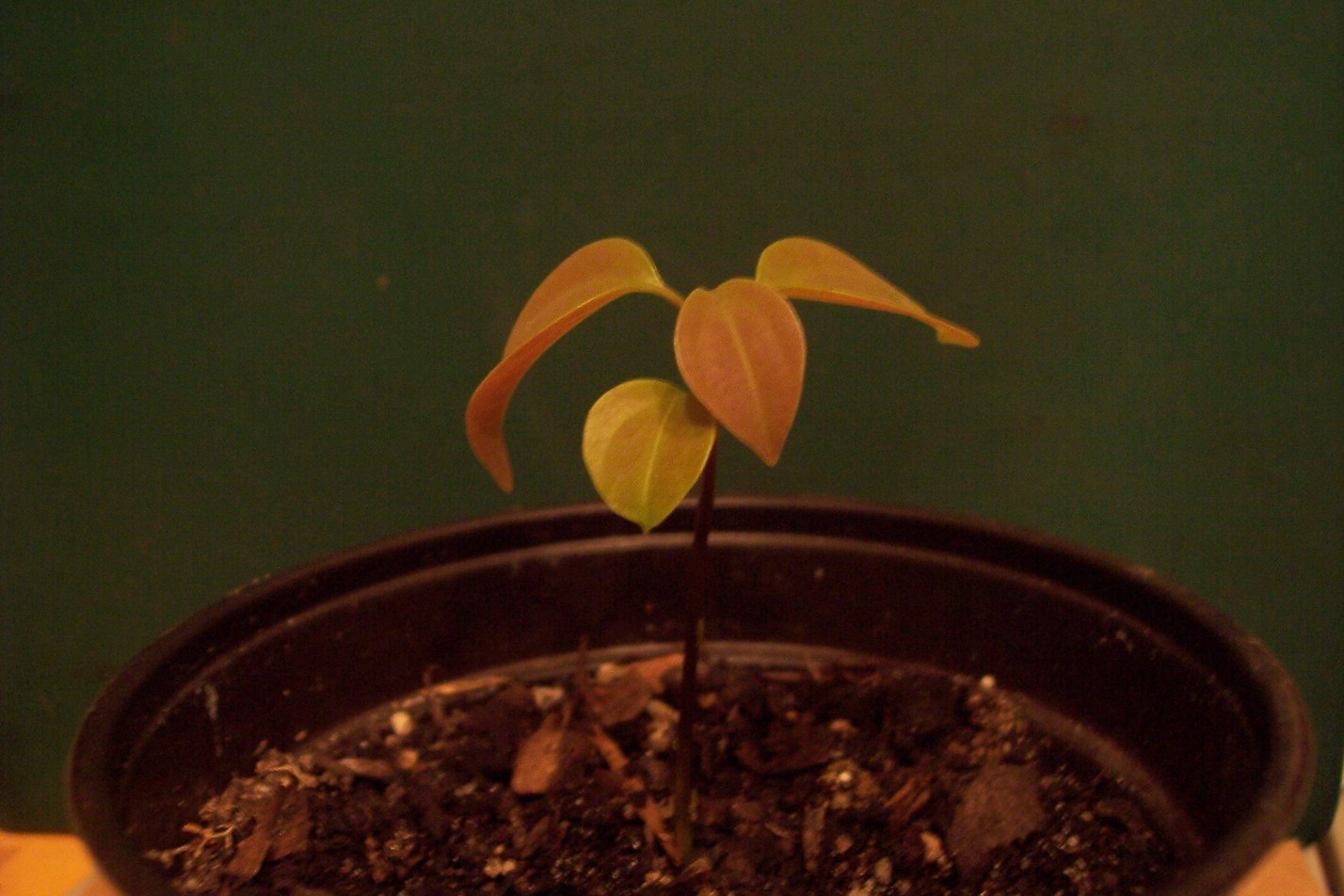
planted Prattville, Alabama
Ceylon Cinnamon vs Casia (Indian/Chinese, Vietnamese, and Indionesian) Cinnamon
Ceylon cinnamon has been hailed as the "true cinnamon" or the "real cinnamon" that possesses outstanding health benefits
especially for the diabetics and those challenged by obesity and high cholesterol issues. This cinnamon
is native to Sri Lanka and sourced from the plant Cinnamomum Zeylanicum.
Alba cinnamon is the highest grade of Ceylon Cinnamon!
Cassia cinnamon contains a lot more coumarin than true cinnamon (Cinnamomum Zeylanicum).
Coumarin in large dosages can be harmful to the liver and kidneys.
Cassia cinnamon contains about 50 times more coumarin than true Ceylon cinnamon.
Links to Coumarin Studies etc
National Institutes of Health US
Journal of Agriculture and Food Industries US
Bundesinstitut für Risikobewertung (BFR) Germany
|
Type of Cinnamon |
Coumarin Content |
||
|
|
Ceylon Cinnamon, True Cinnamon. Mexican Cinnamon |
0.017 g/kg |
|
| Indonesian Cinnamon, Korintje Cinnamon, Padang Cassia | 2.15 g/kg | ||
| Saigon cinnamon, Vietnamese cassia. Vietnamese cinnamon | 6.97 g/kg | ||
| Cassia Cinnamon or Chinese Cinnamon | 0.31 g/kg |
How Cinnamon is Harvested and Processed
|
How to care for your plant
Cinnamon Plants do not handle frost well. Our suggestion is to keep it in a planter inside the home preferably near a window with ample sunlight. It can be put outside during months when the temperatures remain above 35 degrees. Young plants are especially susceptible to freezing temperatures. Water moderately throughout the year but do not over water - do not over-water the pant as it will lead to root rot.
If you plant the Cinnamon in an area of the country where climate conditions allow for outdoor planting, plant it in an area that provides sun to partial shade. Protect the tree from hard freezes and prolonged cool weather. A cinnamon tree can survive short mild freezes. Cinnamon trees are grown for three years and then pruned every other year. The roots will send up a dozen or so shoots called tillering that should be allowed to grow for one year. The spice is obtained from the inner bark, harvest the woody stems, they will grow back. The outer bark is removed from the stem and the inner bark yields the Cinnamon. FYI Cinnamon is a difficult plant to propagate, germination does not guarantee survival. Cinnamon is also susceptible to a variety of insects and especially popular with the white fly. It is prudent to keep a close eye on plants less than 3 years old to guard against insect damage.
Harvesting Cinnamon
The trees grow as leafy bushes, usually maxing out about 3 meters (10 ft) in height. They are first harvested at 3 years old, and continue producing well for 40-50 years.
The spice is obtained from the inner bark, harvest the woody stems, they will grow back. The outer bark is removed from the stem and the inner bark yields the Cinnamon. To obtain Cinnamon follow these steps:
It is important that the cinnamon be obtained from the stem immediately after cutting, otherwise it will dry and it will not be possible to separate the inner layer from the stem.
Other uses
The wood or dry leaves when added to a fire place gives of a great aroma; when added to the charcoal or wood in barbeques it adds a great flavor to any dish being prepared over an open fire.
The leaves can be steamed to produce Cinnamon Oil. Cinnamon Oil can also be extracted from the dried cinnamon quills. The leaves and twigs or inner dried bark are subjected to steam distillation. The leaves yield 1.6 - 1.8 % and the bark 0.5 - 1.00 % oil.
The plant if added to the house will yield a wonderful aroma. As with any other woody plant, it produces new shoots to replace the limbs that have been harvested.
Herbal Medicine In Sri Lanka, Herbal (Homeopathic) Doctors recommend the use of cinnamon for a variety of ailments:
|
Shipping Requested
$12.25
|
Cinnamon |

|
Cinnamon |
| (Shipping and Handling $3.25 per container)
80 in Currently Stock
|
Ground Cinnamon 6 Pack Special
Ground Cinnamon 12 Pack Special
Cinnamon 10 Packs of Sticks
|
(334) 669-5240 (334) 568-2009 (334) 587-6719
|
|
 |